What Are Examples of Managed Services?
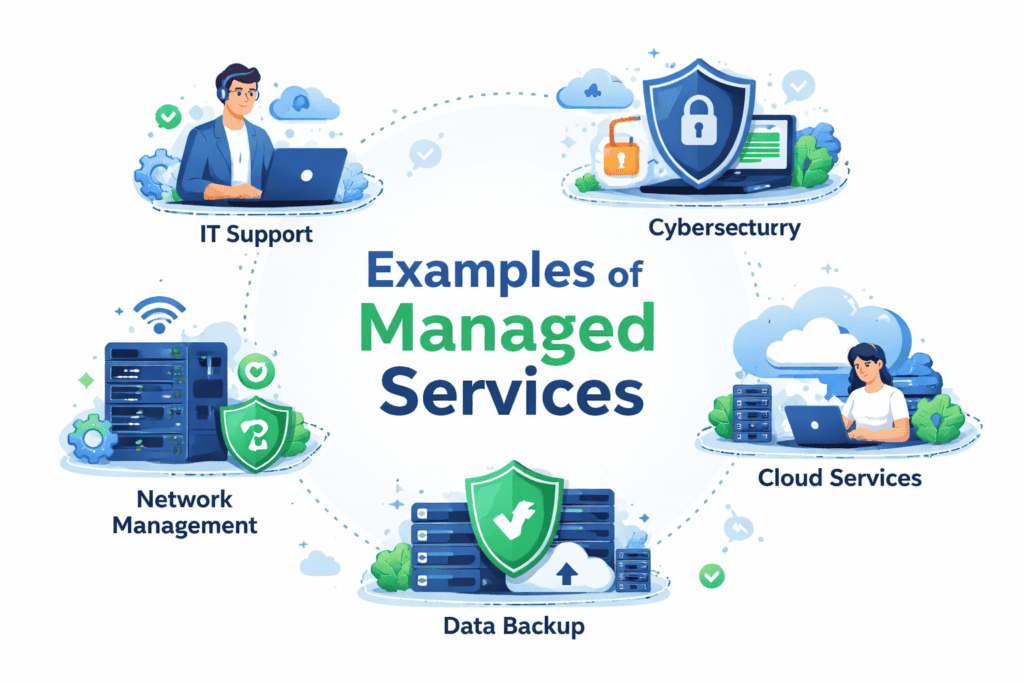
These examples of managed services help businesses reduce downtime, improve security, and keep IT running smoothly.
Businesses today rely on technology for almost everything, from communication and customer service to data storage and cybersecurity. However, managing all of that in-house can be expensive, time-consuming, and difficult, especially for small and growing businesses. That is where managed services come in.
Managed services are professional IT services delivered by an external provider who monitors, maintains, and supports a business’s technology systems on an ongoing basis. Instead of waiting for something to break, managed service providers work proactively to keep systems running smoothly. As a result, businesses can reduce downtime, improve security, and focus more on growth.
Understanding Managed Services
Managed services are usually provided under a monthly service agreement. In other words, a business pays a predictable fee for ongoing support, monitoring, and maintenance. This is different from the old break-fix model, where a company only calls for help after a problem happens.
For example, if a business has a managed IT provider, that provider may monitor servers, install software updates, protect systems from cyber threats, back up data, and help staff with technical issues. Therefore, the business gets continuous support rather than one-time repairs.
To understand how ongoing IT support works in practice, explore our Managed IT Services Australia page for a closer look at the solutions businesses use every day.
Why Businesses Use Managed Services
Many businesses choose managed services because they want reliable support without building a full internal IT department. Moreover, managed services can help companies access specialist skills that may otherwise be too costly to hire internally.
There are several benefits:
- predictable monthly costs
- faster issue resolution
- proactive monitoring
- better cybersecurity support
- reduced downtime
- access to expert IT knowledge
- more time to focus on core business tasks
In addition, managed services can scale with the business. As a company grows, its IT needs usually become more complex. A managed service provider can adjust support levels accordingly.
Common Examples of Managed Services
Managed services can cover many areas of business technology. Below are some of the most common examples.
1. Managed IT Support
Managed IT support is one of the most common services businesses use. It includes day-to-day technical help for computers, software, users, and devices. For instance, if an employee cannot access email, has printer issues, or needs help with software, the managed IT provider can assist.
Additionally, managed IT support often includes remote troubleshooting, system maintenance, and helpdesk services. This makes it easier for businesses to keep staff productive.
2. Managed Network Services
A business network connects computers, phones, servers, printers, and internet systems. If the network is slow, unstable, or insecure, it can affect the whole business. Managed network services help monitor and maintain routers, switches, firewalls, and wireless systems.
As a result, businesses can improve network performance and reduce disruptions. Furthermore, network issues can often be identified and fixed before users even notice a problem.
3. Managed Cybersecurity Services
Cybersecurity is now a major concern for businesses of all sizes. Managed cybersecurity services help protect systems, data, and users from threats such as malware, ransomware, phishing, and unauthorised access.
This service may include:
- antivirus and endpoint protection
- firewall management
- threat detection and monitoring
- vulnerability scanning
- email security
- security updates and patching
Most importantly, managed cybersecurity services focus on prevention as well as response. Therefore, businesses are not only reacting to threats but also actively reducing risk.
4. Managed Cloud Services
Many businesses now use cloud platforms for storage, collaboration, and software access. Managed cloud services help businesses set up, monitor, optimise, and secure their cloud environment.
For example, a managed provider may support Microsoft 365, Google Workspace, cloud servers, or cloud backups. In addition, they may help with user access, storage planning, licensing, and cloud security settings.
This is especially useful for businesses with remote or hybrid teams. Since staff can work from different locations, reliable cloud support becomes even more important.
5. Managed Backup and Disaster Recovery
Data loss can happen for many reasons, including human error, cyberattacks, hardware failure, or natural events. Managed backup and disaster recovery services help businesses protect important files and recover quickly if something goes wrong.
Typically, this service includes automatic backups, secure offsite storage, backup testing, and recovery planning. Consequently, businesses are better prepared for unexpected incidents.
Without a proper backup and recovery plan, even a simple issue can turn into a major business disruption. That is why this managed service is often seen as essential rather than optional.
6. Managed Server Services
Servers store, process, and manage important business data and applications. Managed server services involve monitoring server health, applying updates, managing performance, and addressing issues before they become serious.
Whether the server is on-site or in the cloud, regular maintenance is necessary. Otherwise, poor performance or downtime can affect users, systems, and customers. For that reason, many businesses prefer to have professionals handle this area.
7. Managed Email Services
Email is still one of the most important tools in any business. Managed email services help businesses maintain secure, reliable, and well-configured email systems.
This may include spam protection, user account setup, email migration, security controls, and troubleshooting. Moreover, managed email support can improve communication and reduce the risk of email-based cyber threats.
8. Managed Endpoint Services
Endpoints include laptops, desktops, mobile phones, tablets, and other connected devices. Managed endpoint services help businesses monitor, secure, and maintain these devices.
For example, a provider may install updates, enforce security settings, manage antivirus software, and track device health. As businesses rely more on mobile and remote work, endpoint management becomes increasingly important.
9. Managed VoIP and Communication Services
Modern business communication often depends on internet-based phone systems and collaboration tools. Managed VoIP services help businesses manage phone systems, call quality, user setup, and communication performance.
In the same way, providers may support video conferencing tools, messaging platforms, and communication integrations. This ensures that teams can stay connected internally and externally.
10. Managed Compliance and IT Policy Support
Some businesses operate in industries with strict compliance, privacy, or security requirements. Managed services can also include help with IT policies, system controls, documentation, and compliance-related support.
Although this may not be the first service businesses think of, it can be very important. After all, strong IT systems are not only about performance but also about meeting legal and industry expectations.
Which Managed Services Are Best for Small Businesses?
Small businesses do not always need every type of managed service at once. Instead, they usually benefit most from a practical combination of core support services.
A common starting point includes:
- managed IT support
- cybersecurity monitoring
- cloud support
- backups and disaster recovery
- network management
This combination helps cover the most important business needs. At the same time, it keeps costs more manageable. Later on, businesses can expand services as their needs grow.
How to Know If Your Business Needs Managed Services
A business may need managed services if:
- staff often face technical problems
- there is no dedicated IT team
- systems are not regularly maintained
- cybersecurity risks are increasing
- downtime affects productivity
- backups are inconsistent
- business growth is putting pressure on current systems
If any of these sound familiar, then managed services may be a smart next step. In many cases, businesses wait until problems become urgent. However, proactive support usually saves more time and money in the long run.
Many examples of managed services are designed to help businesses improve performance, strengthen security, and reduce day-to-day IT issues.
Final Thoughts
Managed services are designed to make business technology more reliable, secure, and easier to manage. Rather than handling every issue internally, businesses can partner with experts who provide ongoing support and proactive maintenance.
Examples of managed services include managed IT support, network cybersecurity, cloud management, backup and disaster recovery, server management, email support, endpoint management, communication systems, and compliance support. Together, these services help businesses reduce risk and improve efficiency.
Ultimately, the right managed services depend on the size, goals, and day-to-day operations of the business. Nevertheless, for many organisations, managed services are no longer just a convenience. They are a practical way to stay productive, secure, and prepared for growth.
For trusted advice on protecting business systems and data, you can also visit the Australian Cyber Security Centre for practical cybersecurity guidance.