What Is the Difference Between IT Services and Managed Services?
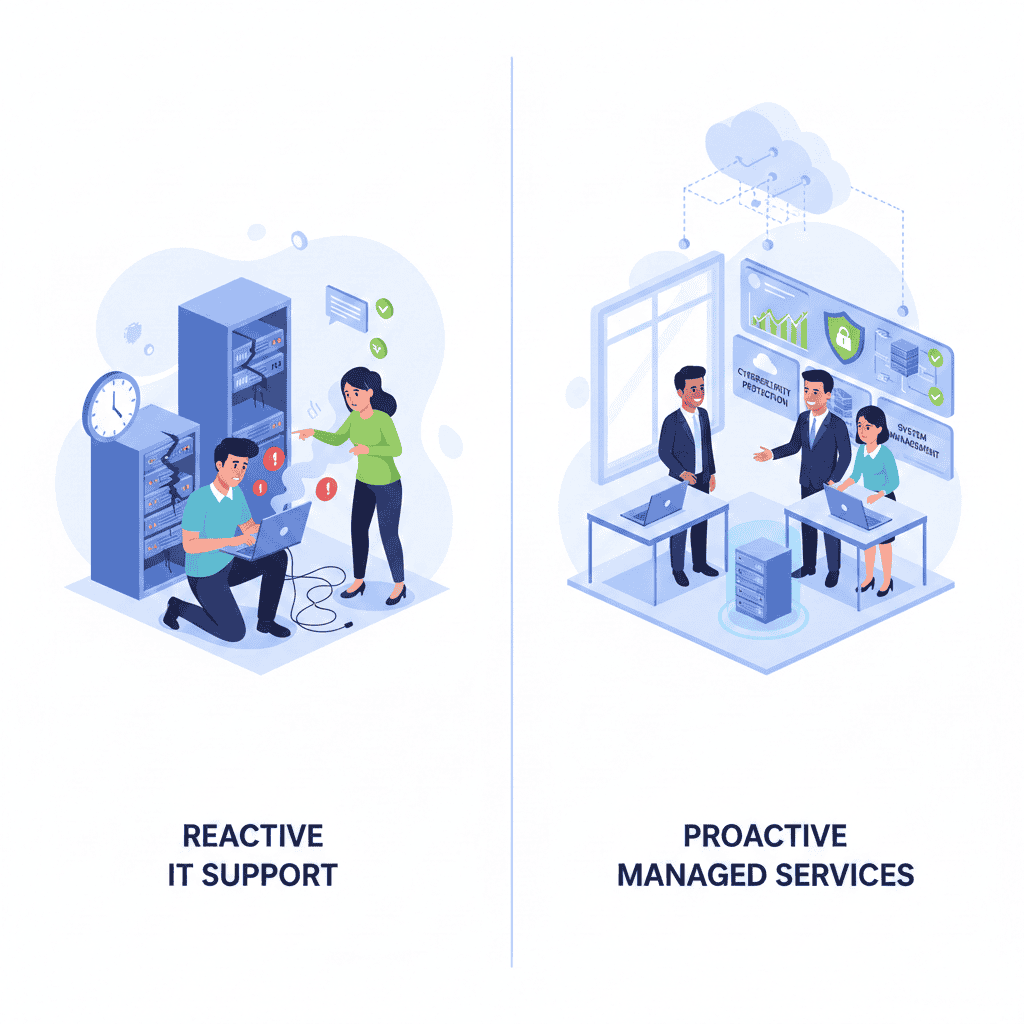
Understanding IT services vs managed services helps businesses choose the right support model for long-term growth.
Businesses rely on technology every day, whether for communication, operations, security, or customer service. However, many business owners still get confused when they hear terms like IT services and managed services. At first, they may sound similar. In reality, they are not exactly the same.
Understanding the difference between IT services and managed services is important because it helps businesses choose the right kind of support. Some companies only need help when something breaks. Others need ongoing support, proactive monitoring, and long-term IT management. Therefore, knowing how these two service models work can save time, money, and unnecessary stress.
To explore proactive support in more detail, visit our Managed IT Services Australia page and see how ongoing IT management helps businesses stay secure and efficient.
IT services vs Managed services: the main difference
Information Technology services is a broad term. It refers to any type of technical support, solution, or assistance provided for a business’s technology needs. For example, IT services can include computer repairs, software installation, network setup, email configuration, cybersecurity support, cloud migration, and troubleshooting.
In many cases, traditional IT services are provided on demand. That means a business contacts an IT provider when a problem happens or when a specific project needs to be completed. For instance, a company may call an IT technician to fix a server issue, install new hardware, or solve an email problem.
This approach is often called the break-fix model. In other words, the business waits until something goes wrong, and then the IT provider steps in to fix it. While this can work in some situations, it is not always the most efficient option. After all, waiting for problems to happen can lead to downtime and disruption.
iT services vs managed services for business
Managed services are a more proactive and ongoing type of IT support. Instead of helping only when something goes wrong, a managed service provider continuously monitors, maintains, and supports a business’s systems.
Usually, managed services are delivered under a monthly agreement. This means the provider handles ongoing IT tasks such as system monitoring, software updates, cybersecurity checks, backups, patch management, and helpdesk support. As a result, businesses receive regular maintenance and support rather than one-off assistance.
For example, if a company uses managed services, its provider may notice a security issue, storage problem, or software failure before staff even report it. Then, the provider can fix or reduce the issue early. Consequently, the business experiences fewer disruptions and more stable performance.
Reactive support in IT services vs managed services
The main difference between IT services and managed services is the way support is delivered.
Traditional IT services are often reactive. The provider responds when a business requests help or when a problem appears. Managed services, on the other hand, are proactive. The provider works continuously in the background to prevent issues, improve performance, and keep systems secure.
That is the biggest distinction. However, there are also several other important differences.
1. Reactive Support vs Proactive Support
This is one of the clearest differences.
With standard IT services, support usually begins after a problem is discovered. For example, a business may call for help because staff cannot access email, the network is down, or a device has stopped working.
With managed services, many issues are addressed before they become serious. For instance, systems may be monitored 24/7, updates may be applied regularly, and security threats may be detected early. Therefore, businesses can reduce downtime and avoid preventable problems.
Simply put, IT services often focus on fixing issues, while managed services focus on preventing issues.
2. One-Time Help vs Ongoing Support
Traditional IT services are often project-based or issue-based. A business may hire an IT provider for a specific task, such as setting up a new office network, installing business software, or repairing a faulty computer.
Managed services are ongoing. The relationship does not end after one task is completed. Instead, the provider continues supporting the business over time. In addition, they may review system performance, identify risks, and recommend improvements regularly.
This ongoing support model is especially useful for businesses that depend heavily on technology and cannot afford repeated interruptions.
3. Unpredictable Costs vs Predictable Monthly Pricing
Cost structure is another major difference.
With basic IT services, charges are usually based on time, labour, or a specific project. If a business has frequent technical issues, the costs can become unpredictable. One month may be quiet, while another month may involve urgent repairs and extra expenses.
Managed services usually come with a fixed monthly fee. Because of this, businesses can budget more easily and understand what level of support they will receive. Moreover, the predictable pricing model often makes it easier to plan for long-term IT needs.
Although managed services may seem like a bigger commitment at first, they often reduce the risk of sudden emergency costs later.
4. Limited Monitoring vs Continuous Monitoring
In a traditional IT service model, monitoring may not happen unless it is requested as part of a project or support package. That means issues can build up without being noticed until they affect staff or customers.
Managed services usually include continuous monitoring of systems, devices, backups, and security events. As a result, problems can be identified much earlier. For example, low disk space, failed backups, suspicious login attempts, or server performance issues can be spotted before they turn into major disruptions.
This proactive approach is one of the main reasons many businesses move toward managed services.
5. Basic Problem Solving vs Strategic IT Management
Traditional IT services often solve immediate technical problems. That support is useful, but it may not always include long-term planning or strategy.
Managed services often go beyond day-to-day support. A managed service provider may also help with technology planning, cybersecurity improvements, cloud adoption, infrastructure upgrades, and business continuity. In other words, they do not just fix technical issues. They help businesses manage technology more effectively over time.
Therefore, managed services can offer both technical support and strategic value.
6. Different Levels of Security Support
Cybersecurity is now a serious business concern. For that reason, the support model matters.
Traditional IT services may help after a cybersecurity issue occurs. For example, a provider may remove malware, restore data, or repair affected systems.
Managed services usually include a more preventive security model. This may involve patching, endpoint protection, firewall monitoring, email security, backup checks, and user access controls. Consequently, businesses have stronger protection before a threat becomes a full incident.
This is particularly important for small and medium-sized businesses, which are often targeted but may not have internal security teams.
IT services vs managed services for business
There is no one-size-fits-all answer. It depends on the business’s size, budget, risk level, and technology needs.
Traditional IT services may be suitable for businesses that:
- only need occasional technical help
- have simple systems
- already have internal IT staff
- want project-based support only
Managed services may be better for businesses that:
- depend on technology every day
- want fewer disruptions
- need ongoing support
- want stronger cybersecurity
- do not have an internal IT department
- prefer predictable monthly costs
For many businesses, managed services offer better long-term value. This is because prevention is often less expensive than emergency repair. In addition, ongoing support helps systems stay secure, updated, and more reliable.
Can a Business Use IT services vs managed services together?
Yes, absolutely. In some cases, businesses use both IT services and managed services together.
For example, a company may have a managed service provider handling monitoring, backups, helpdesk support, and security. At the same time, it may still use separate IT specialists for one-off projects such as website migrations, office relocations, or software development work.
So, these models are not always competing with each other. In fact, they can work together depending on the needs of the business.
Why IT services vs managed services matters
Choosing the wrong support model can create unnecessary problems. If a business only uses reactive IT support, it may face repeated downtime, inconsistent maintenance, and delayed issue resolution. On the other hand, if a business invests in managed services when it barely uses technology, it may end up paying for more support than it currently needs.
That is why understanding the difference matters. It helps businesses make smarter decisions based on how they operate, how much support they need, and how much risk they are willing to carry.
Final Thoughts
The difference between IT services and managed services mainly comes down to reactive support versus proactive support. IT services are often used when a business needs help with a specific issue, repair, or project. Managed services, by contrast, provide ongoing support, continuous monitoring, and long-term system management.
Both models have value. However, managed services are often the better choice for businesses that want stability, security, and consistent IT performance. Meanwhile, traditional IT services may still be useful for one-time support or project work.
Ultimately, the right option depends on the business itself. Nevertheless, as technology becomes more critical to daily operations, more businesses are choosing managed services to stay secure, efficient, and prepared for growth.
For trusted guidance on business cybersecurity and system protection, you can also visit the Australian Cyber Security Centre for practical resources and advice.